Confidence in the saddle isn’t something you either have or you don’t. It develops, changes, and gets tested as you grow as a rider.
That’s why I like thinking about confidence as a rider in four different levels. Figuring out where you currently fall gives you a tangible way to look at your progress—and, more importantly, figure out what you need to work on next.
Maybe you realize there’s an area where you need to up your game. Or maybe you finally recognize that all the work you’ve been putting in is actually paying off.
Either way, knowing where you are gives you information instead of leaving you guessing about why your confidence feels solid in some situations and completely disappears in others.
Riding skill and riding confidence aren’t the same thing
Before we get into the four levels, there’s one really important distinction: your skill as a rider and your confidence as a rider are not the same thing.
You can be a highly skilled rider who struggles with confidence when the pressure rises. You can also be a relatively inexperienced rider who trusts themselves, makes decisions, and doesn’t fall apart every time something goes wrong.
That matters because a lot of riders assume:
- I’ll finally be confident when I’m a better rider.
- I’ll be confident when I stop making mistakes.
- I’ll be confident when I start winning.
But becoming technically better doesn’t automatically create confidence.
Confidence affects how decisively you ride, how well you stay focused, how willing you are to challenge yourself, and how quickly you recover when something goes wrong. Instead of using all your mental energy second-guessing yourself or worrying about the what ifs, you have more attention available for your horse and the job in front of you.
You can be a highly skilled rider and still struggle with confidence. More skill does not automatically create more self-belief.
So where does your confidence fall right now?
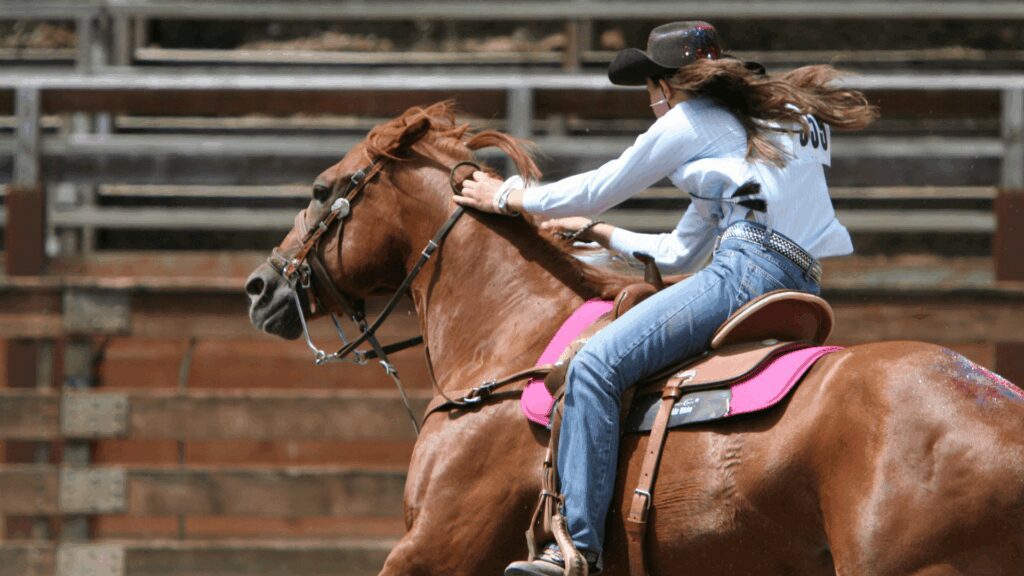
Level 1: The Anxious Amateur
At Level 1, your confidence feels a little like a house of cards in a gusty barn. It might be there, but it doesn’t take much to knock it over.
And remember: this does not necessarily reflect your riding ability.
You might be able to pull off a beautiful lead change at home or work a cow without breaking a sweat when everything feels familiar. But add pressure, uncertainty, another person watching, or the possibility of making a mistake and suddenly your confidence disappears.
At this level, you may find yourself avoiding situations that make you uncomfortable, second-guessing your decisions, or needing a lot of reassurance that you’re doing things correctly.
The goal isn’t to eliminate every anxious thought. It’s to start building enough self-trust that nerves don’t get to make every decision for you.
Level 2: The Hesitant Hopeful
At Level 2, confidence is growing—but it isn’t consistent yet.
Think of it like a yo-yo. Some days you feel capable and ready to take on more. Other days, one mistake or difficult ride sends you right back into doubt.
You’ve probably experienced enough success to know what you’re capable of, which is a huge step forward. The problem is that you don’t completely trust that ability yet.
You may want to enter the bigger class, try the harder maneuver, increase the speed, or step outside your comfort zone. Part of you is thinking, I think I can do this.
Another part is still asking, But what if I can’t?
This stage is where learning to act despite uncertainty becomes incredibly important. You don’t need to feel 100% confident before taking the next step.
Level 3: The Comfortable Execution Zone
By Level 3, confidence is no longer something you have to think about constantly. It has started becoming another tool you can rely on.
You’re better at problem-solving when a ride doesn’t go according to plan. Challenges don’t automatically feel like proof that you aren’t good enough, and you’re more willing to stretch yourself because you trust your ability to handle what happens next.
Riding often becomes more enjoyable here too.
Instead of spending so much energy worrying about whether you can handle a challenge, you can actually engage with it. You can experiment, learn, make adjustments, and enjoy the training process with your horse.
Confidence has stopped needing to be the star of the show. It has become your reliable sidekick.
Level 4: The Confident Cowgirl or Cowboy
At Level 4, confidence has become resilient.
That doesn’t mean you never get nervous, make mistakes, have a terrible ride, or encounter something that rattles you. It means those things no longer have the same power to define what happens next.
A high-energy crowd, a difficult horse, bad weather, a mistake in the show pen, or an unexpected problem might challenge you—but your confidence can survive the challenge.
You’re able to channel pressure into focus. When something goes wrong, your brain starts looking for information rather than immediately labeling the experience a failure.
Maybe you love the adrenaline of big stops, fast runs, or rank cows. Maybe your version of success is developing a horse that trusts you and continuing to improve together.
Either way, you trust yourself enough to keep riding, learning, adjusting, and moving forward.
What level of confidence are you?
Now comes the useful part: identifying where you actually are.
You don’t need to judge yourself for being at Level 1 or convince yourself you should already be at Level 4. These levels are meant to give you direction, not another reason to beat yourself up.
If you’re at Level 1, work toward Level 2. If you’re at Level 2, start developing the skills that move you toward Level 3. If you’re comfortable at Level 3, look at what still changes when the pressure gets bigger.
One level at a time.
Then ask yourself:
What do I need to let go of to move into the next level?
Maybe it’s the belief that you have to feel completely ready before you compete. Maybe you need to stop treating every mistake like evidence that you aren’t good enough. Maybe you need to let go of constantly comparing your progress to another rider’s.
Then ask what needs to change in your actions. Do you need to take a calculated risk? Enter the class? Ask for more? Practice riding under pressure instead of only practicing when you feel comfortable?
Knowing your level is useful. Doing something with that information is what changes your riding.
Ready to level up your confidence in the saddle?
If you recognize yourself in the Anxious Amateur or Hesitant Hopeful—or you’re tired of having confidence at home and losing it the second the pressure rises—5 Days to Confident Competitor can help you start changing that.
Over five days, you’ll work on the mental skills that help you stay steadier, trust yourself, and ride with more confidence when it actually matters.
You don’t need to become a completely different rider overnight. You just need to start moving toward the next level.
Join 5 Days to Confident Competitor →
Happy Trails!
Nicole Burnett
Mental Coach & Founder, Resilient Reiner
Read Next
If pressure, overthinking, or show nerves have been getting in the way of your best rides, 5 Days to Confident Competitor is a simple place to start.
This five-day training helps you understand what happens in your brain and body when the pressure rises, so you can begin building tools to steady yourself, communicate more clearly with your horse, and ride with more confidence.
Start Building Show-Pen Confidence
I'm ready to stop show nerves →
Your horse feels what you bring into the saddle.
When pressure hits, your body, timing, focus, and confidence all affect the ride your horse gets.
Nicole Burnett is a mental performance coach for western riders who want their mindset to match their skill, their horse, and their goals.
Through practical mindset coaching and nervous system training, Nicole helps riders stay steady, communicate more clearly, and ride more effectively — whether they’re rebuilding confidence at home, sharpening their show-pen mindset, or preparing to compete on the national stage.
Work With Nicole
Explore ways to work with Nicole →
