Why Do Affirmations + Positive Self-Talk Work on Instagram but Not in the Warm-Up Pen?
5/19/26
Positive self-talk is easy on Instagram.
It gets a lot harder in the warm-up pen, when your horse feels fresh, your trainer is watching, the gate is getting closer, and your body is already buzzing.
A lot of riders start with affirmations because they want to feel more confident. They tell themselves, “I’ve got this,” “I’m calm,” or “I trust my horse.” And sometimes, that helps.
But when pressure hits, your brain and body may not believe the words coming out of your mouth.
That does not mean positive self-talk is useless. It means riders need more than pretty phrases when their nervous system is already fired up.
In this post, we’ll talk about why positive self-talk can fall flat under pressure — and what actually helps when you need to stay focused, regulated, and effective in the warm-up pen or show pen.
Why positive self-talk can fall flat under pressure — here’s what riders actually need instead
A lot of riders have tried affirmations, positive self-talk, and the whole “be confident” thing.
They know what they should be saying to themselves.
They’ve heard the advice. They may even believe in it.
And yet, the second the pressure hits, none of it seems to help.
That’s the part no one talks about enough.
Because it is incredibly frustrating to know the “right” thing to think… and still feel your chest tighten, your brain get loud, and your confidence disappear the moment it counts.
So first: if that has happened to you, it does not mean you are weak. It does not mean you are broken. And it definitely does not mean mindset work does not work.
It means the advice was incomplete.
A lot of well-meaning advice stops at “Just be positive”
Raise your hand if anyone has said any of the following to you.
- Just be positive.
- Be confident.
- Use affirmations.
- Psych yourself up and just go ride.
- You’ve got this!
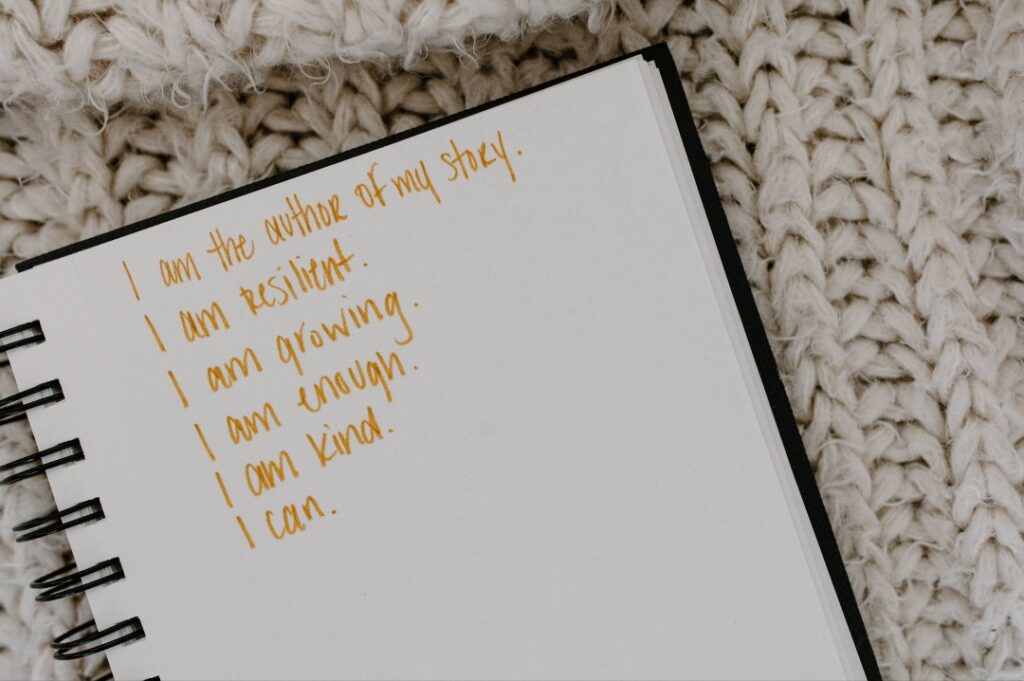
And to be fair, I love affirmations and positive self-talk.
They can be powerful. They can reinforce identity. They can help you practice better patterns. They can absolutely support confidence.
But I kept noticing the same pattern as a coach to other riders: when riders were under real pressure, they often could not access those “better thoughts” consistently.
They knew what they wanted to say to themselves. They knew what they should be thinking. But in the warm-up pen, at the gate, after a mistake, or when all the eyes were on them, those better thoughts suddenly felt far away.
That is when I realized the issue was not only what riders were saying to themselves.
It was also what was happening in their nervous system.
And that is exactly why nervous system work became such a central part of what I teach.
Positive self-talk is not about pasting pretty phrases over panic
When pressure hits, your brain stops sounding like a coach and starts sounding like Chicken Little screaming that the sky is falling.
It starts scanning for danger.
It gets louder.
It gets harsher.
It gets dramatic.
And if you do not understand what is happening, it is very easy to make that mean something about you.
Maybe you tell yourself you are not confident enough.
Maybe you decide everyone else belongs there more than you do.
Maybe you start thinking, “What is wrong with me? I know better than this.”
But under pressure, this is rarely only a thought problem.
It is a state problem.
What pressure actually does to riders
When your nervous system reads the moment as high-stakes, your breathing changes. Your body tightens. Your focus narrows. Your timing changes. Your decision-making changes. Your horse feels it too.
That is why a rider can look totally capable at home and then feel like a completely different person when it counts.
That is why one bobble can snowball into a full spiral.
What this looks like in real life
Picture this: you are fine unloading, fine tacking up, maybe even fine jogging around at first. Then you look around the warm-up pen, see riders you perceive as stronger or more polished, and your brain starts firing.
Do not mess this up.
Everyone else knows what they’re doing.
You do not belong here.
Do not let people see you blow it.
Now you get tight. You stop riding proactively. You start second-guessing. Your horse feels the hesitation. The ride gets worse.
And suddenly that original thought feels true.
But the thought felt true because your body reacted to it.
That does not make it true.
It means the spiral was already affecting the ride.
Why affirmations & positive self-talk can feel great at home… and useless under pressure
That is why affirmations can feel great when you are calm in your kitchen… and completely useless in the warm-up pen.
Not because affirmations are stupid.
Because your system is already in protection mode.
And when that is happening, the goal is not to force the biggest, shiniest positive thought you can come up with.
The goal is to say something your system can actually receive.
What effective self-talk actually needs to be. (Hint: it’s not just positive self talk)
From years of coaching and experience, I’ve found that under pressure, effective self-talk needs to be three things:
1. Believable
Not so big that your brain rejects it.
2. Regulating
It should help settle your system, not create more internal argument.
3. Directional
It should bring your focus back to the ride, the cue, the next job.
If your self-talk is not believable, regulating, and directional, it probably will not hold up under pressure.
What riders actually need to do instead of only relying on positive self talk
That is why under pressure, riders do not need bigger, happier thoughts first.
They need to:
1. Regulate the body
2. Interrupt the story
3. Return to the next job
That might sound like:
- “Breathe.”
- “Come back to this moment.”
- “One job at a time.”
- “You do not need to prove anything right now.”
- “I can feel pressure and still ride.”
- “My job is to be clear, not perfect.”
Do you feel the difference?
That is not fake positivity.
That is self-leadership.
That is a rider knowing how to come back to herself when her brain gets loud.
Why so many riders stay stuck in the cycle of trying to fix show nerves with positive self talk
And that is the piece so many riders are missing.
They are trying to fix a pressure response with better thoughts alone.
Meanwhile, the real problem keeps showing up in the same places:
- in the warm-up pen
- at the gate
- after a mistake
- when expectations rise
- when people are watching
- when it finally matters
This is why so many riders look capable at home and then feel like a different person under pressure.
It is why one mistake snowballs.
It is why timing disappears, second-guessing takes over, and the ride stops reflecting the skill that is actually there.
You do not need a better affirmation. You need more than positive self talk. You need a better way back to yourself.
So no, you are not failing because you have not found the right affirmation yet.
And no, it does not mean confidence is out of reach for you.
It means you may need more than a thought.
You may need a way to calm your system so the thought can actually land.
That is where everything changes.
Because once your body is no longer fighting for survival, your mind becomes far more coachable.
Now the cue lands.
Now the breath helps.
Now the thought becomes something you can use instead of something you are trying to force.
You do not need to feel like the most confident rider in the pen.
You need to know how to come back to yourself when your brain gets loud.
Want help with what you as a rider can do besides positive self talk?
That is why confidence under pressure is not built by trying harder to “be positive.”
It is built by learning how to regulate your system, interrupt the spiral, and refocus before your brain hijacks the ride.
And that is exactly why I created 5 Days to Confident Competitor.
Inside, I walk you through tools that help you stop the mental tailspin, regulate your system, and come back to calm, clear riding when it counts.
If you are tired of knowing better but still spiraling when the pressure is on, 5 Days to Confident Competitor is for you.
[Join 5 Days to Confident Competitor]
Ride on with confidence,
Nicole
Read Next
If pressure, overthinking, or show nerves have been getting in the way of your best rides, 5 Days to Confident Competitor is a simple place to start.
This five-day training helps you understand what happens in your brain and body when the pressure rises, so you can begin building tools to steady yourself, communicate more clearly with your horse, and ride with more confidence.
Start Building Show-Pen Confidence
I'm ready to stop show nerves →
Your horse feels what you bring into the saddle.
When pressure hits, your body, timing, focus, and confidence all affect the ride your horse gets.
Nicole Burnett is a mental performance coach for western riders who want their mindset to match their skill, their horse, and their goals.
Through practical mindset coaching and nervous system training, Nicole helps riders stay steady, communicate more clearly, and ride more effectively — whether they’re rebuilding confidence at home, sharpening their show-pen mindset, or preparing to compete on the national stage.
Work With Nicole
Explore ways to work with Nicole →
