For years, I kept going to the App Store looking for an app that I was absolutely certain someone must have made.
I wanted a training tracker for my horses.
Not barn-management software. Not something for managing invoices, veterinary records, employees, or an entire lesson program. And not a GPS tracker designed primarily to tell me where, how far, or how fast I rode.
I wanted somewhere to keep track of the actual training:
- Which horses have I worked with?
- What did we do?
- What are we trying to build?
- How consistently have I been working with each horse?
- What has all of that work been adding up to?
I knew exactly why I wanted it.
I was tired of trying to carry every horse’s entire training program inside my head.
I tried the whiteboard. I tried notebooks. I tried relying on my memory. I repeatedly searched the App Store, tried different horse apps, and hoped I had finally found what I needed.
I hadn’t.
So eventually, I stopped waiting for someone else to make it.
I built it.
It is called Every Horse: Training Tracker, and it is now available for iPhone in the Apple App Store.
“I know I worked with you recently…”
This was the thought I kept having when I looked at one of my horses:
“I know I worked with you recently.”
But was it yesterday or three days ago?
What did we work on?
Did I ride, do groundwork, or just do something quick?
Was that the session where something started to click—or was that with a different horse?
That doesn’t mean I’m not paying attention to my horses. It means I have multiple horses, a business, clients, a podcast, a life, and one human brain.
Every horse also has different needs.
I may have one horse working on lead changes. With that horse, I want several solid sessions each week that move his training forward and build on the work we did previously.
A younger horse may need something completely different. For him, the greatest value may come from consistency and exposure. Saddling him, getting on, and doing something useful for fifteen minutes can be an important session.
Sometimes the purpose of a ride is skill development.
Sometimes it is consistency.
Sometimes it is exposure.
Sometimes I get on and long trot for twenty minutes because the horse needs physical conditioning.
Not every ride needs to accomplish every goal.
A fifteen-minute consistency session is not a failed version of a major training session. A conditioning ride isn’t less valuable because we didn’t learn something new. Groundwork, lessons, lunging, and hand walking count too.
The challenge is remembering all of it accurately.
I wanted an external brain that could preserve the information while leaving the actual horsemanship decisions to me.
The whiteboard that became wall decoration
Every training barn has a whiteboard.
Approximately 99 percent of the time, it is something the trainer’s wife lovingly made five years ago, and now it is covered in dust because nobody actually uses it.
I say that with love.
I made a whiteboard for myself, too.
I had a vision of keeping it beautifully updated so I could see every horse’s training plan. In reality, I had to remember to walk over to it, find a marker, update it, and then remember to look at it again later.
Eventually, it became wall decoration.
I also love the fantasy of a training notebook.
In that fantasy, I finish riding, sit peacefully with a cup of tea, open my beautifully organized notebook, and thoughtfully record everything I learned.
No one needs me. Nothing interrupts me. There’s definitely no flies or mosquitoes pestering me. And I always know where the notebook is.
Actual Nicole does not consistently do this.
Even when I wrote something down, it was difficult to answer broader questions:
- How many times have I ridden this horse during the last month?
- Have we mostly been conditioning, or have we also been developing skills?
- How long did we practice a particular exercise before the next piece clicked?
The information might technically have existed somewhere, but it wasn’t usable.
What I built instead
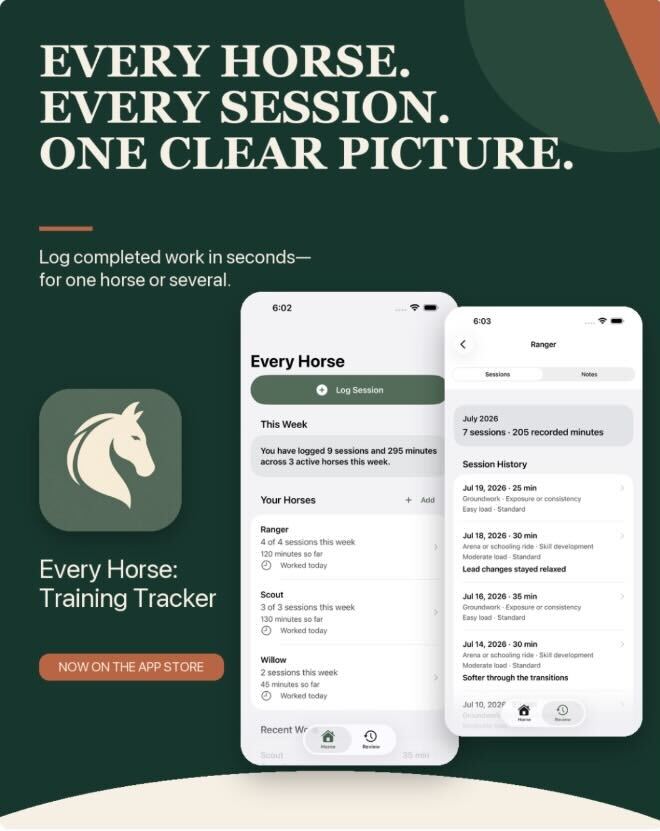
Every Horse gives me a place to quickly record what I did after working with a horse.
That could be a ride, groundwork, lunging, hand walking, a lesson or clinic, competition, or another type of session that matters to me.
I can record the purpose of the work—such as consistency and exposure, skill development, conditioning, or a mixture—along with the physical load and any quick note I want to remember.
Then I can look back across the week, month, twelve weeks, or year and see what has actually been happening.
Each horse can also have an individual work goal.
One horse might have a goal of four sessions a week. When I had a horse in training, my goal might have been to ride him once a week because I was going for a weekly lesson.
If a horse is taking time off, I can pause that horse instead of having the app act as though I am falling behind.
The goal isn’t to impose the same schedule on every horse. It is to reflect the actual plan for that horse right now.
The unexpected effect: I’m riding more consistently
Since I started using Every Horse, I have found myself riding more consistently.
I think it is partly because I feel like I get credit for the work.
That sounds slightly ridiculous, even to myself. But we all know life is a mind game, and I absolutely have perfectionist tendencies.
Without something keeping track, it is easy for my brain to turn riding into an enormous assignment:
- I need to ride every horse.
- I need enough time for a real training session.
- I need to make meaningful progress.
If I can’t do all of that, it can feel easier not to begin.
But if I know I can hop on bareback, spend ten minutes practicing steering, record it, and let that session count for exactly what it was, I am genuinely more likely to do it.
Not because the app pressures me. It doesn’t use broken streaks or guilt trips to tell me I have failed.
The work simply becomes visible.
I can look back and say:
“Yes, I showed up today. That counted. I am being consistent.”
Having the plan outside my brain has also reduced the constant pressure.
Instead of walking into the barn thinking, “I need to ride every single horse today,” I can see what I have actually done.
Maybe I rode everybody on Tuesday.
Maybe today, riding one horse is enough.
Maybe one horse needs a complete training session while another needs fifteen useful minutes.
Taking away the pressure to do everything has helped me do more of the small sessions I might otherwise have skipped.
Brumby’s first lead change
One of my favorite examples is my mustang, Brumby.
Brumby recently did his first lead change. I’m so proud of him.
Before asking him for it, I had been working on hip yields in preparation. At the walk, I would put my leg on, swing his hip to the inside for one stride, and then continue.
It was a small exercise. We weren’t drilling lead changes for an hour. We were quietly preparing the pieces.
I recorded that work in Every Horse.
Looking back, I could see that we had worked on those hip yields over approximately three weeks.
Then I asked him for the lead change… And it worked!
Of course, I recorded his first lead change in the app too.
Every Horse didn’t train Brumby or tell me how to teach the maneuver. What it did was preserve the story.
It showed me the quiet work that came before the visible milestone.
That is training.
Training isn’t only the exciting moment when something finally works. It is all of the ordinary sessions that made that moment possible.
I want to be able to see those too.
Where Every Horse fits
Most horse apps I found were created for one of two purposes.
Barn-management systems help run a business or facility. GPS trackers record routes, distances, speeds, and elevation, which can be particularly useful for endurance and trail riders.
Every Horse is built around a different set of questions:
- What did I work on?
- Why did I ride today?
- What did I notice?
- What have we been doing consistently?
- What has all of this work been adding up to?
It lives in the training relationship between a rider and a horse.
It isn’t trying to run your barn or map your route. It is built to help you record the work, recognize the patterns, and see what you are building with each horse.
Information—not another guilt trip
I did not want to build an app that made riders feel bad.
Horse training already contains enough emotion.
Horses get sore. Weather happens. The arena freezes. Work becomes overwhelming. Horses need time off. Sometimes riders need time off too.
Every Horse is designed to be calm and factual:
- Here is what you did.
- Here is what you have been building.
- Here is where each horse currently stands.
- Now you can decide what makes sense next.
The purpose is awareness, not judgment.
Sometimes that awareness may reveal an area that needs attention. Sometimes it reveals that you have been doing far more than you thought.
Many riders walk around feeling vaguely behind. We remember everything we haven’t done while discounting the fifteen-minute rides, groundwork days, conditioning sessions, and quiet preparation that didn’t immediately produce a dramatic result.
When that work becomes visible, you can see it accumulating.
You haven’t been doing nothing.
You have been training.
Built for real horse life
I built Every Horse from my life as a Western rider. My world includes reining, ranch riding, ranch versatility, young horses, lessons, training sessions, and trail riding.
But this problem is not limited to one discipline.
Every Horse is for riders who have horses with individual goals, want to become more consistent, or want a clearer picture of the work they are doing.
You might have one horse or several.
You might compete, trail ride, take lessons, bring along young horses, or simply want to become more intentional about your riding.
The discipline may change, but the desire to understand what you and your horse are building is remarkably universal.
Most importantly, I am using Every Horse in my actual barn life. After real rides, when I am tired, distracted, and ready to move on to the next thing.
It had to be quick enough to use consistently and detailed enough to be meaningful when I looked back.
It needed to understand that groundwork counts. That conditioning and skill development are not the same thing. That horses need different goals. That ten useful minutes can matter.
I built the app I kept searching for.
And honestly, I love using it.
Download Every Horse for iPhone
Every Horse: Training Tracker is available now for iPhone.
You can try every feature free for seven days. After that, continue for $4.99 per month or $39.99 per year.
There are no ads, and you do not need to create an Every Horse account.
Download Every Horse from the Apple App Store
You can also open the App Store and search for Every Horse Training Tracker. Look for the green icon with the horse.
If you try it, I would genuinely love to hear about your experience. Tell me how many horses you have, what kind of riding you do, what you find useful, and what feels confusing.
Sometimes you train for an hour.
Sometimes you hop on bareback and practice steering for ten minutes.
Sometimes you work on one quiet piece for three weeks—and then your horse does his first lead change.
It all counts.
Now you have somewhere to see it.
Keep every horse in work—without keeping it all in your head.
Android Riders: Help Test Every Horse
The Android version of Every Horse is currently completing the testing required before it can be released publicly in the Google Play Store.
At the time of publication, I need five more Android riders who can remain enrolled for fourteen days, use the app with their real horses, and give me candid feedback.
No positive review or public post is required. I want to understand what the app is genuinely like to use.
To participate, DM me on Instagram at Nicole Burnett Mental Coach or email nicole@nicoleburnettcoaching.com.
If pressure, overthinking, or show nerves have been getting in the way of your best rides, 5 Days to Confident Competitor is a simple place to start.
This five-day training helps you understand what happens in your brain and body when the pressure rises, so you can begin building tools to steady yourself, communicate more clearly with your horse, and ride with more confidence.
Start Building Show-Pen Confidence
I'm ready to stop show nerves →
Your horse feels what you bring into the saddle.
When pressure hits, your body, timing, focus, and confidence all affect the ride your horse gets.
Nicole Burnett is a mental performance coach for western riders who want their mindset to match their skill, their horse, and their goals.
Through practical mindset coaching and nervous system training, Nicole helps riders stay steady, communicate more clearly, and ride more effectively — whether they’re rebuilding confidence at home, sharpening their show-pen mindset, or preparing to compete on the national stage.
Work With Nicole
Explore ways to work with Nicole →
