If you’ve ever wondered how to get your horse to respond to you, there’s a moment every rider knows.
You pick up your reins. You ask for a stop, a turn, a transition… and your horse gives you something, but it’s delayed, dull, bracey, sticky, or just… not you.
And immediately your brain goes: “He’s being disrespectful.”
Or “She’s ignoring me.”
Or “Why do I have to kick so hard?”
Or the classic: “My horse is lazy.”
Sometimes it is a training or clarity issue. Sometimes it’s physical. Sometimes it’s you asking at the wrong moment, in the wrong position, with unclear timing.
And sometimes… it’s your nervous system.
Not in a woo-woo way. In a “your body is broadcasting a signal your horse can feel” way.
Why your horse doesn’t respond to your best intentions
Most riders intend to be calm and clear.
But horses don’t respond to the best intentions stuck inside your warm cozy bed back at the ranch. They respond to what’s happening in your body right then in the saddle:
- your breath (or lack of it)
- your muscle tone (tight vs. soft)
- your eyes (wide + scanning vs. steady)
- your rhythm (rushing vs. consistent)
- your energy (frantic, braced, shut down, grounded)
So you can be thinking: “Just lope off… please lope off…”
…but your body is saying: “Something’s wrong. Brace for impact. Actually, let’s not lope just yet.”
And your horse does what horses do with that signal: they brace, hesitate, dull out, or get reactive.
The hidden reason your horse “doesn’t listen”
Here’s a hard truth that’s also really good news:
If your nervous system is in fight/flight (you feel amped, tight, urgent) or freeze (shut down, numb, disconnected), your aids get messy.
Not because you’re bad. Because your body is doing what it was designed to do under pressure: protect you.
Protection looks like:
- holding your breath through the ask
- tightening your legs without realizing it
- clamping your thighs
- pulling instead of guiding
- getting “louder” with your cues because you’re not getting an immediate answer
- trying to force responsiveness instead of building it
Your horse feels all of that… and then we get stuck in the cycle:
Horse doesn’t respond →
rider gets frustrated/tight →
cues get unclear/loud →
horse braces or dulls →
rider escalates →
horse checks out or blows up.
It’s not a character flaw in your horse. It’s communication inside a nervous-system storm.
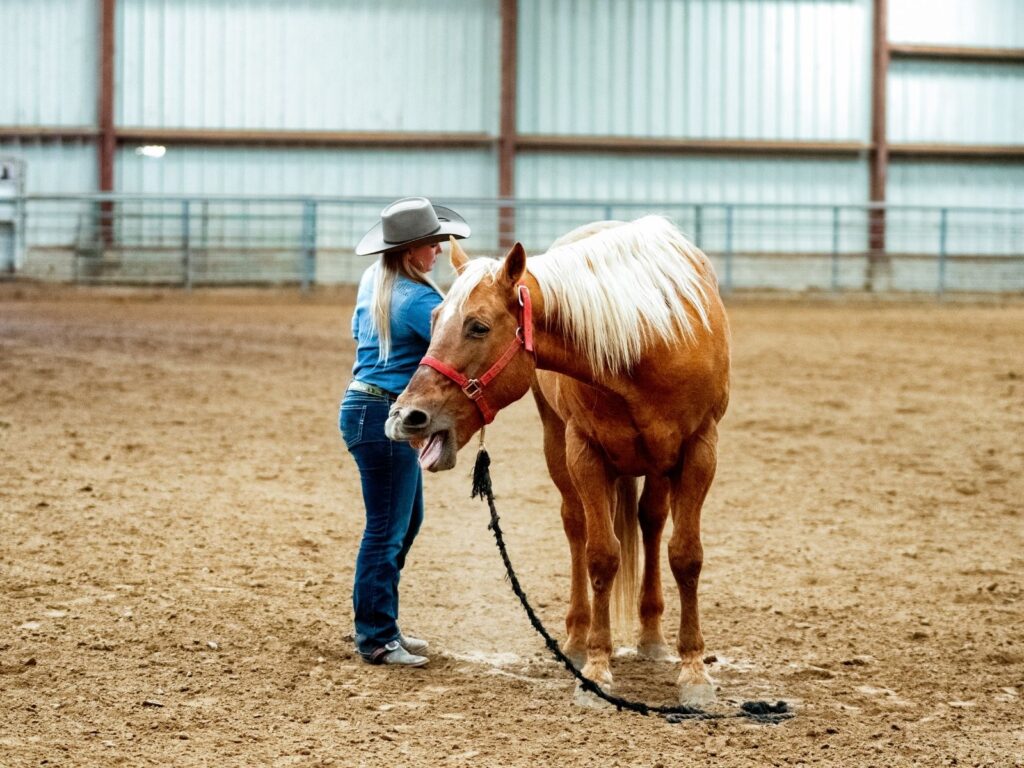
How to get your horse to respond to you
This is where people get it twisted: they think responsiveness is created by more pressure.
But the best responsiveness usually comes from clarity + timing + a regulated rider.
Because a regulated rider can:
- ask once, clearly
- release fast
- keep their body quiet
- stay emotionally neutral
- hold steady pressure without escalating
- stay patient long enough for the horse to find the right answer
That’s what creates a horse who starts hunting the cue and hunting for that “right answer” instead of resisting it.
A simple reset before you ask for more responsiveness
Before you even mount up (or right before you ask for something that tends to get sticky), try this:
1) Exhale longer than you inhale (3 rounds).
Inhale through your nose for a count of 4.
Exhale for a count of 6–8.
Do that three times.
Why? Because long exhales tell your nervous system: “We’re safe.”
And a “safe” rider gives cleaner signals.
2) Soften your eyes.
Instead of laser-focusing on one thing, widen your visual field. Let your eyes take in the whole arena.
Horses read predator eyes vs. calm eyes. Wide, soft vision changes your entire energy.
3) Pick one “quiet body” cue.
Choose one: heavy heels, soft jaw, loose hands, long thigh.
Just one.
You’re not trying to become a monk. You’re trying to become consistent.
Then go ask your horse for something simple—like a walk-to-trot transition—and see if your timing and clarity improve without you “doing more.”
The “response” you’re really training to get your horse to respond to you
Yes, we’re training the horse to respond to leg, rein, seat, voice, whatever.
But you’re also training your own response:
- When your horse is dull, do you tighten and nag… or pause, breathe, clarify, and re-ask?
- When your horse is reactive, do you brace and escalate… or soften and lead?
- When something goes wrong, do you spiral… or stay present?
That’s the real difference between riders who feel like they’re always fighting for control… and riders who look like their horse is reading their mind.
Their horse isn’t psychic.
They’re just regulated and consistent.
If you want help training this, start here
If this helps at home but disappears the second you haul out or feel watched, that’s your sign you don’t need more willpower — you need nervous system training.
This is exactly why I created 5 Days to Confident Competitor.
It’s a simple, low-stress way to build your “calm switch” so you can:
- get your body back online fast
- stop overreacting mid-ride
- stay clear when your horse gets sticky, dull, or emotional
- and ride in a way that makes your horse want to respond
It’s $33, and it comes as five short audio emails. Easy to follow. No fluff. Real tools you can use today—at home or at a show.
If you’re ready to stop trying harder and start riding clearer, grab 5 Days to Confident Competitor here.
Because the fastest way to get your horse to respond to you…
is to become the kind of rider your horse can understand.
Always in your corner.
Ride on with confidence, friend,
Nicole
Read Next
If pressure, overthinking, or show nerves have been getting in the way of your best rides, 5 Days to Confident Competitor is a simple place to start.
This five-day training helps you understand what happens in your brain and body when the pressure rises, so you can begin building tools to steady yourself, communicate more clearly with your horse, and ride with more confidence.
Start Building Show-Pen Confidence
I'm ready to stop show nerves →
Your horse feels what you bring into the saddle.
When pressure hits, your body, timing, focus, and confidence all affect the ride your horse gets.
Nicole Burnett is a mental performance coach for western riders who want their mindset to match their skill, their horse, and their goals.
Through practical mindset coaching and nervous system training, Nicole helps riders stay steady, communicate more clearly, and ride more effectively — whether they’re rebuilding confidence at home, sharpening their show-pen mindset, or preparing to compete on the national stage.
Work With Nicole
Explore ways to work with Nicole →
