You might not have a confidence problem because you’re incapable.
You might have a confidence problem because part of you is uncomfortable admitting how capable you actually are.
I see this with riders all the time. They downplay what they know, hesitate to make decisions without their trainer, brush off their accomplishments, or worry that confidently saying I’m good at this will make them look arrogant.
But there’s a big difference between confidence and arrogance.
And constantly making yourself smaller doesn’t make you humble. It can keep you from becoming the rider you’re capable of being.
Why confidence in horse riding matters
I started thinking about this after talking with a good friend of mine. She’s in her 40s, she’s capable, and she’s been around horses since she was a kid.
Yet she was talking about herself like she couldn’t do anything without her trainer.
It was interesting to hear someone with so much experience treat herself as though she couldn’t trust her own knowledge.
I’m a huge believer in having support. Trainers, mental coaches, vets, bodyworkers, riding friends, and mentors can all make you better.
But at the center of that support system is still you and your horse.
When you’re in the saddle, you’re the one making decisions. You’re feeling what your horse is doing underneath you. Your brain is telling your hands and legs how to respond.
The goal should be to get help when you need it without losing trust in your own ability.
Confidence helps you ride more decisively
We’re working with thousand-pound animals. Even a wonderful horse can spook, stumble, react unexpectedly, or put you in a situation where you need to make a decision quickly.
When you’re constantly second-guessing yourself. Maybe this? Maybe that? your cues and decisions can become less clear.
Confidence doesn’t mean assuming you know everything. It means trusting yourself enough to use the knowledge and skills you already have.
That clarity matters for performance too. A confident rider is more willing to try something new, work through a difficult maneuver, take calculated risks, and recover when something inevitably goes sideways.
Because what is horseback riding if not regularly dealing with something you did not plan for?
Confidence isn’t believing you’ll always get it right. It’s trusting yourself to respond when you don’t.
When trainer support becomes trainer dependency
There is absolutely nothing wrong with relying on a good trainer. The right trainer brings expertise, perspective, and experience that can dramatically improve both you and your horse.
The problem begins when support quietly turns into:
I can’t do this without my trainer.
There’s an important difference between a trainer who helps you become more capable and a relationship that leaves you believing you’re helpless without them.
Ideally, good coaching gives you more tools, better judgment, and greater independence over time.
This becomes especially important when fear is involved. Your horse can spend months in professional training, but if the emotional reason you are struggling never gets addressed, your horse may be progressing while you stay stuck.
Your horse is getting trained.
Are you?
Think of your trainer as a mentor and guide rather than proof that you can’t do this yourself. Build a great support system, ask questions, and learn from people who know more than you—but keep taking ownership of your own riding.
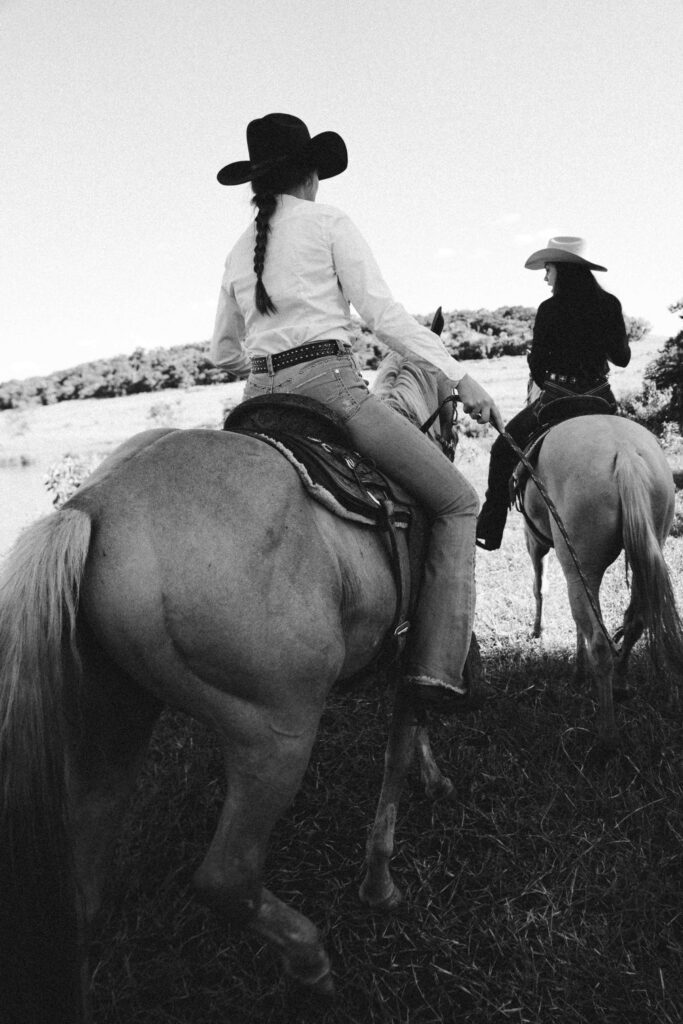
Are you embarrassed to admit you’re good?
Here’s where confidence gets really interesting.
Sometimes riders aren’t afraid they’re bad.
They’re afraid of what people will think if they admit they’re good.
Especially in the Western world, where humility matters, nobody wants to be the obnoxious person walking around telling everyone how amazing they are.
So we can swing too far in the opposite direction.
You win and immediately explain why it wasn’t that impressive. You master something and brush it off. You become better than you used to be and start worrying that your friends will think you’re showing off.
You’re allowed to say:
I’m good at this.
Maybe you really are good at setting up a turn. Maybe you have great feel. Maybe you’ve become a strong competitor.
Acknowledging that doesn’t mean you think you’re a better person than somebody else.
It means you can accurately recognize a strength.
Stop making yourself smaller as you improve
Leveling up can feel surprisingly uncomfortable.
Maybe you start winning more. Something that used to be difficult becomes easier. You begin riding at a different level than some of the people around you.
And instead of enjoying that growth, you start thinking:
- I don’t want them to think I’m showing off.
- What if they judge me?
- I don’t want to make anybody feel bad.
So you minimize what you’ve accomplished.
That’s not necessary.
Confidence and arrogance are not the same thing. You can acknowledge your accomplishments without putting somebody else down. You can be proud of your progress while still remaining coachable, kind, and humble.
In fact, seeing another rider confidently pursue something can show other people what’s possible.
You don’t have to pretend you suck to make everyone else comfortable.
Confidence and capability are two different things
This is where I think a lot of riders get stuck.
Capability is your actual skill, knowledge, and competence.
Confidence is your belief in your ability to use those skills.
You can have confidence without enough capability, which can become dangerous overconfidence.
But you can also have plenty of capability and very little confidence.
And I see that combination all the time.
You know more than you think you do. You have years of experience. You have the riding skills. Yet the second pressure rises, you stop trusting yourself.
That’s why simply becoming a better rider doesn’t guarantee you’ll become a more confident one.
There are incredibly accomplished riders who still struggle with confidence. More saddle time can improve your physical skills, but it doesn’t automatically teach your brain what to do with pressure, fear, doubt, or competition.
You have to train both.
Train your confidence alongside your riding
Your confidence isn’t fixed, and neither is your capability.
As your skills improve, you give yourself more evidence that you can handle difficult situations. As your confidence grows, you become more willing to actually use those skills when the pressure is on.
That creates a powerful feedback loop.
So check in with yourself occasionally:
- Where have my riding skills genuinely improved?
- Where do I still need more training?
- What am I already good at that I keep minimizing?
- Where is self-doubt stopping me from using skills I already have?
- Am I getting support because it helps me grow—or because I’m afraid to trust myself?
You may discover that the next step isn’t becoming dramatically better before you finally give yourself permission to feel confident.
Maybe you need to start acknowledging the rider you’ve already become.
Ready to stop second-guessing yourself in the saddle?
If you know you’re capable but struggle to feel like the confident rider you want to be, that’s exactly the kind of mental work we start inside 5 Days to Confident Competitor.
Over five days, you’ll begin training the mental skills that help you trust yourself, handle pressure, and stop letting overthinking call the shots when it matters.
You’re already training your horse. You’re already putting in the saddle time.
Now train your confidence, too.
Join 5 Days to Confident Competitor →
Happy Trails!
Nicole Burnett
Mental Coach & Founder, Resilient Reiner
Read Next
If pressure, overthinking, or show nerves have been getting in the way of your best rides, 5 Days to Confident Competitor is a simple place to start.
This five-day training helps you understand what happens in your brain and body when the pressure rises, so you can begin building tools to steady yourself, communicate more clearly with your horse, and ride with more confidence.
Start Building Show-Pen Confidence
I'm ready to stop show nerves →
Your horse feels what you bring into the saddle.
When pressure hits, your body, timing, focus, and confidence all affect the ride your horse gets.
Nicole Burnett is a mental performance coach for western riders who want their mindset to match their skill, their horse, and their goals.
Through practical mindset coaching and nervous system training, Nicole helps riders stay steady, communicate more clearly, and ride more effectively — whether they’re rebuilding confidence at home, sharpening their show-pen mindset, or preparing to compete on the national stage.
Work With Nicole
Explore ways to work with Nicole →
